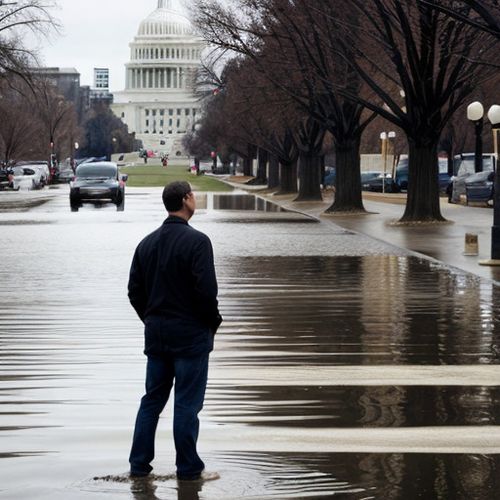
In the heart of America's capital city, the bustling streets of Washington, D.C., are beginning to feel the chill of an economic winter. The recent wave of job cuts, orchestrated by the Trump administration and executed by Elon Musk's government efficiency team, has left tens of thousands of federal workers, contractors, and local residents grappling with uncertainty. This is not just a story of lost jobs; it is a tale of disrupted lives, strained businesses, and a city teetering on the edge of a potential recession.
Tyler Wolf, a 32-year-old employment attorney, recently found himself among the ranks of the unemployed after being laid off from his position at the US Department of Health and Human Services. With dreams of buying a home and moving in with his girlfriend this year, Wolf now faces a stark reality: moving back in with his parents in Virginia and cutting back on spending. "I'm lucky that I don't have children or a mortgage because it gives me a bit more flexibility, but this is definitely going to set me back quite a bit," he said. Wolf's story is emblematic of the thousands of individuals whose lives have been upended by the administration's overhaul of the federal workforce.
The impact of these job cuts extends far beyond the individuals directly affected. Consumer spending, a key economic engine of the city, is showing signs of strain. With a significant portion of the population losing their steady income, nonessential spending has been the first casualty. Restaurants, cafes, and retail stores are feeling the pinch as consumers tighten their belts. Miloud Benzerga, owner of Timgad Café in the Ronald Reagan Building and International Trade Center, estimates that foot traffic to his shop has dropped by 25% to 30% since the job cuts began. "It makes me sad that a lot of people are losing their jobs, and of course, that has something to do with my business, too," Benzerga said. "If it gets worse, we'll have to close, and I am not the only one."
The data paints an even more alarming picture. According to government statistics, there are approximately 2.4 million federal workers in the United States, excluding those employed by the military and the Postal Service, with 17% residing in the DC metropolitan area. So far, the Trump administration has fired at least 103,452 workers nationwide, though some of these cuts are being challenged in court. Economists at Moody's warn that the District of Columbia could slip into a recession as early as this year, with the full impact likely to be felt in the second half. Oxford Economists project a staggering 33,700 federal job losses in the DC metro area in 2025, amounting to $4.9 billion in lost wages. These job cuts represent more than just numbers; they are a harbinger of economic turmoil that could ripple through the entire metropolitan area.
The housing market is also showing signs of distress. Realtor.com data indicates that homes listed for sale began to increase sharply in late January, with a 56.2% rise in the week of March 8 compared to the same period last year. Danielle Hale, chief economist at Realtor.com, noted that while many households may choose to stay in the area and seek new job opportunities, others will likely leave to retire or find work elsewhere. "So far, we're seeing more homes on the market, and modestly lower asking prices, but the situation continues to evolve," Hale said.
For those affected by the job cuts, the road ahead is fraught with challenges. Alexandra Reid, a 30-year-old program specialist laid off from the National Institutes of Health, described the immediate impact on her household income. "I have stopped pretty much all spending on nonessentials since I received the termination notice, only making food, grocery, and transportation purchases as a protective measure," she said. Reid's situation is not unique. The job market is already strained, with economists predicting that this year's job losses will outpace the market's ability to absorb the influx of unemployed federal workers.
Despite the bleak outlook, there are glimmers of hope. On Thursday, a federal judge ruled that thousands of probationary employees who were laid off must temporarily regain their positions. For Reid, this ruling offers a glimmer of optimism. "I am hopeful I'll get my job back soon," she said.
Businesses, too, are seeking ways to adapt. Chinyere Hubbard, president of the DC Chamber of Commerce, reported increased interest from businesses in the chamber's resources and events. "We're hearing concerns from businesses about the overall reduction in local business activity but also about the federal cuts," Hubbard said. The upcoming small-business expo is one example of how the community is rallying to support local enterprises.
Economists warn that the full impact of the job cuts will be felt later in the year, with consumer-facing industries like retail and hospitality likely to be hit hardest. Adam Kamins, director of regional economics at Moody's, suggested that the recession in DC might have already begun in March. "There's always a lag between when things are happening in the economy and when the data reflect those events," Kamins said.
As the city navigates these turbulent waters, the human cost of the job cuts is undeniable. Tyler Wolf, despite the challenges he faces, remains hopeful. "I'm more upset than anything because of the arbitrary nature of all this, but I do feel confident that I'll get back on my feet—with time," he said.
In the end, the story of Washington, D.C., in the face of these job cuts is one of resilience and adaptation. It is a tale of individuals and businesses adjusting to a new reality, of communities coming together to support one another, and of a city that, despite the odds, remains hopeful for a brighter future. The road ahead may be uncertain, but the spirit of those who call DC home is unyielding.

By Emma Thompson/Mar 18, 2025

By Elizabeth Taylor/Mar 18, 2025

By Grace Cox/Mar 18, 2025
By Noah Bell/Mar 18, 2025

By Victoria Gonzalez/Mar 18, 2025

By Ryan Martin/Mar 18, 2025

By Sarah Davis/Mar 18, 2025
By David Anderson/Mar 18, 2025

By Amanda Phillips/Mar 18, 2025

By Amanda Phillips/Mar 18, 2025

By Emily Johnson/Mar 13, 2025
By Amanda Phillips/Mar 13, 2025

By Christopher Harris/Mar 13, 2025

By Michael Brown/Mar 13, 2025

By Samuel Cooper/Mar 13, 2025

By Daniel Scott/Mar 13, 2025